

Selling digital products is one of the simplest ways to start an online business. And for good reason.
You don’t need inventory, shipping, or a large upfront investments.
What you really need is a simple idea and a way to turn it into something that solves a specific problem.
That’s it.
The cool part is this model scales really well. You can create something once and sell it again and again without doing extra work every time.
Selling digital products is one of the best ways to generate passive income.
That’s why so many people are jumping into it right now.
With the right effort and consistency, it can become a reliable source of income for years to come.
In this guide, I’ll walk you through the exact steps to start from scratch, choose the right platform, pick the right product, and actually get your first sales.
Let’s break it down step by step.
How to start selling digital products
This article may contain affiliate links. Please read the Disclaimer to learn more.
What are digital products?
Digital products are things you can sell online that don’t exist in a physical form.
So instead of shipping a box or a package, you deliver everything instantly through a download or online access.
Think ebooks, templates, online courses, printables, presets, or guides. If someone can download it or access it online, it counts as a digital product.
The best part is you create it once, and you can sell it over and over again. No restocking. No shipping. No extra cost per sale.
That’s why this model is so popular right now. It keeps things simple, especially for beginners who want to start making money online without a big setup.
It also works for almost any niche.
Fitness, finance, design, productivity, business, you name it. If you can solve a problem, you can turn it into a digital product.
Why digital products are growing faster than ever
Digital products are not just popular right now. They are everywhere.
And the reason is actually pretty simple.
People want faster solutions. Not long processes or complicated setups. Just something they can buy, download, and use right away.
That’s exactly what digital products give them.
Another big reason is how easy it has become to start. A few years ago, you needed tools, websites, and technical skills just to get going.
Now you can create and sell something from your laptop in a single day. That is huge.
There is also a shift in how people buy online.
Instead of paying for expensive services or long courses, many people prefer smaller, focused products that solve one specific problem.
That creates constant demand across almost every niche.
And then there’s scalability. You create it once and sell it over and over again without extra work each time. No shipping. No inventory. No limits.
That’s exactly why digital products keep growing in popularity.
How to Sell Digital Products (Step-by-Step)
1 Choose a niche you care about
This is where your journey starts.
A lot of beginners get this wrong because they chase whatever looks “popular” or “profitable” at the moment.
But the problem is simple. If you don’t care about your niche at all, you will burn out fast.
And trust me, that’s where most people quit.
So instead, you want to pick a niche you actually enjoy working in. Something you don’t mind thinking about every day.
For example, my niche is Online Business & Marketing. It’s a topic I’ve been interested in long before I started this blog.
My products are built around helping online business owners grow and make more money online, and that’s something I genuinely enjoy.
Start by thinking about:
- What topics you naturally talk or read about?
- What skills you already have or want to learn?
- What problems you enjoy solving for other people?
- What content you can see yourself creating long term?
Then narrow it down by asking yourself:
- Would I still enjoy this in one year?
- Can I see myself helping people in this space every week?
- Is there a real audience already interested in this topic?
After thinking through these questions, you’ll be one step closer to finding your direction.
Warning: It’s great to choose something you enjoy, but you also need an existing audience. Passion alone isn’t enough. You need both interest and demand.
2 Research what people struggle with
Now that you have your niche, it’s time to understand what people actually need help with.
This step is where most beginners either win or fail.
Because if you skip it, you end up creating something based on assumptions. And assumptions don’t sell.
You want real problems. Real frustration. Real conversations happening right now.
For example, in the Online Business & Marketing niche, people are not sitting around thinking “I want a digital product.” No. They are thinking things like:
- Why am I not getting traffic to my blog or page?
- How do I get my first email subscribers?
- What should I even sell online?
- Why is nobody buying my offer?
- How do I grow without posting all day?
These are the moments where people start looking for solutions. And that’s your opportunity.
You don’t need fancy tools for this. Just go where your audience already hangs out:
- Facebook groups in your niche
- Reddit discussions
- YouTube video comments
- TikTok comments under niche videos
- Google searches and “People also ask” sections
Pay attention to repeated questions. If you see the same problem coming up again and again, that’s not random. That’s demand.
Don’t just collect ideas. Look for frustration. That’s where strong digital products are born.
Because when someone is confused or stuck, they are ready to buy a clear solution. (I am talking from personal experience😅)
If you want to do this properly, follow this method: (I know it may be boring at first but it’s crucial)
- Pick 3 places where your audience hangs out
- Spend 20 to 30 minutes reading real questions and comments
- Write down every repeated problem you see
- Circle the ones that feel urgent or painful
- Choose 1 main problem you want to solve later
Once you have that one clear problem, you are ready to turn it into a product.
3 Create a high-value digital product
Now we get to the fun part. This is where your idea turns into something real you can actually sell.
But this is where most beginners get it wrong. They think high value means complicated, like a long ebook, a big course, or fancy design.
That’s not it.
High value simply means one thing. It solves a specific problem in a clear and simple way. The simpler the better.
If your product helps someone go from stuck to “I finally get this”, then it already has value.
Instead of trying to do everything, focus on one clear outcome, one problem, and one result.
Take my ebook below as an example. It solves a very specific problem and gives a clear path from point A to point B.
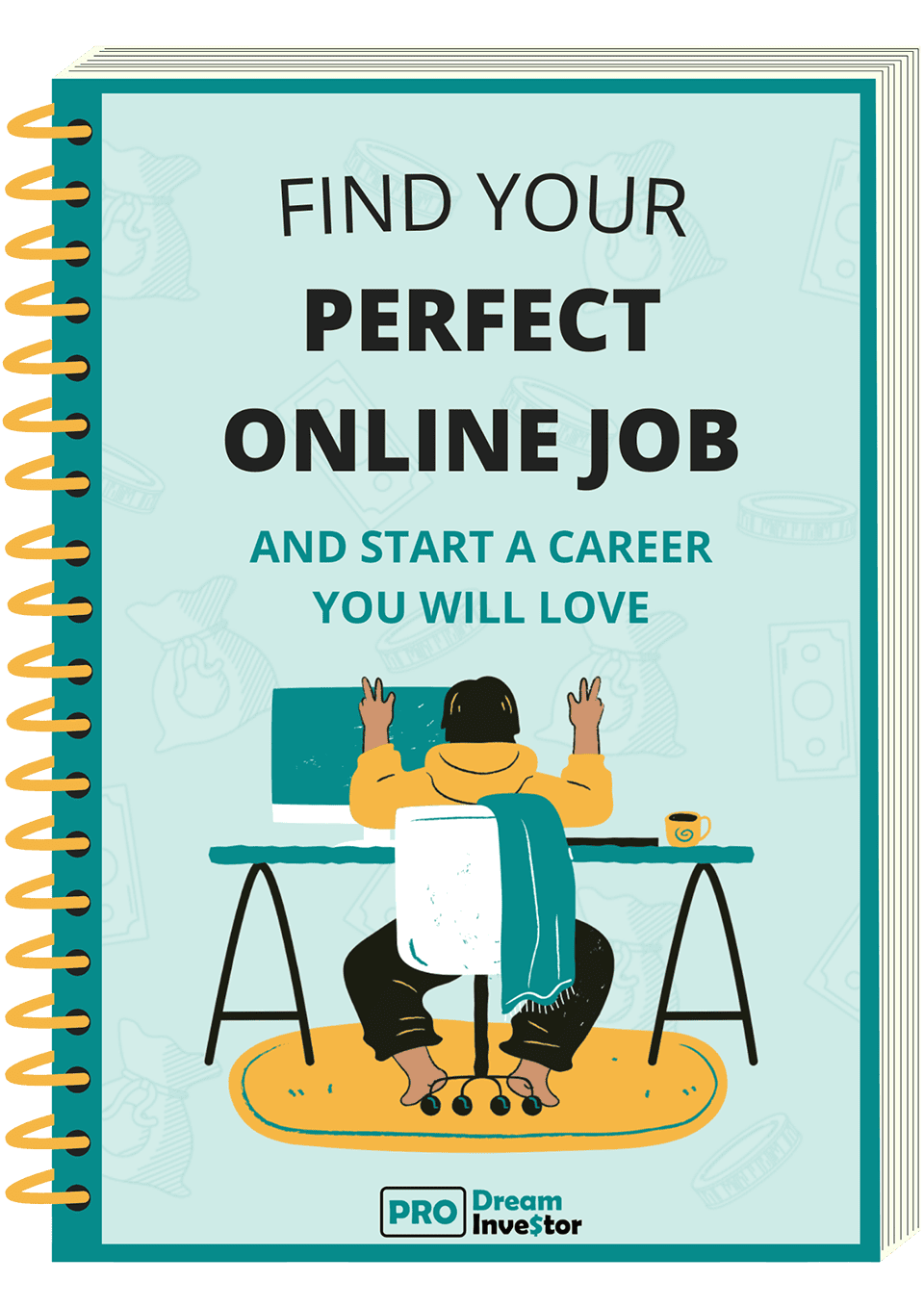
Grab my FREE eBook to discover your perfect online job and learn how to get started today.
Stop trading your time for money and join millions of people working online!
Keep it simple and practical. You are not building something overwhelming. You are building something useful that someone can actually finish and apply.
You can create your products using simple tools like:
- Canva for designing ebooks, templates, and visuals
- Google Docs for writing guides, ebooks, and step by step instructions
- Notion for building systems, planners, and productivity setups
- ChatGPT for helping you structure ideas and speed up writing
The tool does not matter as much as the clarity of your content.
A simple product that solves a real problem will always outperform something complicated that confuses people. Always remember that!
At this stage, your goal is not perfection. Your goal is clarity and usefulness.
Because once someone opens your product and immediately understands what to do, you’ve already done your job.
Pro Tip: If you want to see which digital products are selling like crazy right now, check my full article here. (coming soon)
4 Set up your store
Once your product is ready, the next step is to actually set up your store and make it available for people to buy.
This is also where platforms like Payhip come in, making it easier than ever to sell digital products without dealing with complicated setup.

It keeps the whole process simple by handling payments, file delivery, and checkout automatically, so you don’t get stuck dealing with technical setup.
One of the biggest advantages is that you don’t even need a website to get started.
You can build your own hosted store directly on Payhip and start selling right away.
And if you already have a website or blog, you can simply integrate Payhip by adding buy buttons or links to your existing pages. (that’s what I’m doing)
Payhip works well for beginners because it removes friction. You don’t need coding, design skills, or technical knowledge.
You can just focus on your product and your audience.
Here’s what you can sell on Payhip:
- Digital downloads
- Online courses
- Coaching services
- Memberships
- Physical products
Everything is managed in one place, including delivery after purchase, so customers get instant access without you doing anything manually.
Setting it up goes like this:
- Create your free Payhip account
- Upload your digital product
- Set your price (start low until you build trust)
- Customize your store (optional but recommended)
- Publish and go live
That’s it. Your store is now live and ready to accept payments.
Once this is done, you are no longer “preparing.” You are officially selling.
5 Drive traffic to your store
Now this is the part where everything starts to feel real.
Because you can have the best digital product in the world, but if nobody sees it, nothing happens. And this is where a lot of beginners get stuck.
They think the hard part is creating the product. But in reality, getting attention is what actually matters.
The good news is you don’t need anything complicated here.
You just need to show up on the right social platforms and start putting your offer in front of people who already want what you are selling.
If you want to get your products seen, here are some of the best places to focus on:
- Pinterest: Great for long-term traffic and search-based content
- TikTok: Fast reach and high viral potential even for beginners
- Instagram: Strong for building trust and connecting with your audience
- Threads: Easy text-based content and quick engagement
- YouTube Shorts: Strong for evergreen short-form traffic
- YouTube (long-form): Best for trust-building and deeper content
- Facebook Groups: Great for niche communities and targeted buyers
The goal is simple. You are not trying to go viral. You are trying to get consistent views and clicks from the right people.
Every post should gently lead people back to your store. Not in a pushy way, just a simple “if you want help with this, here’s my guide” approach.
The key here is consistency, and not giving up your efforts. It’s always tough in the beginning.
But with time: More followers = More views = More sales
Start with one platform first. Stick with it. Learn what works. Then expand later.
Because once traffic starts coming in, even slowly, everything changes.
6 Build long term growth
Once you get your first sales, things change.
This is no longer just about making a quick sale. It’s about building something that keeps growing over time.
The biggest mistake here is stopping too early. One product can get you started, but it won’t take you very far on its own.
You want to build momentum.
Here’s how you do it:
- Create more products that solve related problems
- Bundle your best products together for higher value offers
- Build an email list so you can reach your audience anytime
- Improve your existing products based on customer feedback
- Test different traffic sources and double down on what works
- Use Payhip features like discounts or affiliate links to increase reach
This is where things start to compound.
One product leads to another. One audience turns into a repeat customer base. One sale turns into multiple over time.
Keep it simple though. You don’t need to build everything at once. Don’t pressure yourself.
Just focus on improving step by step and staying consistent. That’s how a small digital product business turns into something long term.
Why Payhip works so well for beginners
Choosing the right eCommerce platform can make or break your success.
That’s why I recommend setting up your store using Payhip.
It’s one of the easiest ways to build a fully branded storefront and start selling directly to your audience without any technical stress.
It gives you full control over your brand, pricing, and customer relationships, which is exactly what you want when you’re starting out and building something sustainable.
Payhip also has a built in marketplace where you can list your products for free and get discovered by new customers, even if you don’t have traffic yet.
One of the biggest reasons it works so well for beginners is that it keeps everything simple while still giving you powerful tools to grow.
It also stands out because it offers some of the lowest fees in the industry, which means you keep more of what you earn as you grow.
Features
ᐊ swipe to see more ᐅ
| Feature | What it does | Why it matters |
| Custom checkout | Improves checkout design | Helps increase conversions |
| Apple Pay and 100+ payments | Fast payment options | Makes buying easier and faster |
| Review responses | Sellers can respond to reviews | Builds trust with buyers |
| Cross selling | Suggests extra products | Increases your sales per order |
| Countdown sales | Time limited offers | Creates urgency and boosts sales |
| Built-in marketplace | Public product listing | Helps you get free traffic |
| Collaborations | Revenue sharing with creators | Helps you grow faster through partnerships |
| More payment gateways | Extra global payment options | Increases international sales |
| Coupon code tools | Create discounts and promotions easily | Helps you run marketing campaigns and boost sales |
| License key selling | Sell unique codes or serial keys | Perfect for software, tools, and premium digital products |
ᐊ swipe to see more ᐅ
You can find these features and many more in detail on the official Payhip help page.
Pricing
The best part is you don’t need to invest anything upfront.
You can literally start with the free plan, upload your first product, and test your idea in the real world.
ᐊ swipe to see more ᐅ
| Plan | Price | What you get |
| Free | $0/month + 5% fee | Start selling with no upfront cost |
| Plus | $29/month + 2% fee | Lower fees as you grow |
| Pro | $99/month + 0% fee | No transaction fees for scaling sellers |
ᐊ swipe to see more ᐅ
And that’s exactly why I chose Payhip. It delivers the lowest fees and no upfront costs so you can literaly start today.
Common mistakes to avoid
Most people don’t fail because digital products are a waste of time.
They fail because they make things harder than they need to be or they rush the wrong steps.
If you avoid these mistakes early, you’re already ahead of most beginners.
Here are the most common ones:
- Trying to make the perfect product before launching and never actually publishing anything (perfectionism sucks)
- Choosing a niche based only on interest instead of checking if people are already buying
- Making the product too complicated instead of keeping it simple and focused on one clear result
- Ignoring marketing and expecting sales without showing up or promoting your product
- Spreading effort across too many ideas instead of focusing on one product first
- Giving up too early before getting enough time, feedback, and visibility
The biggest pattern here is simple. People overthink and under-execute.
But digital products reward action, not perfection. You don’t need a perfect start. You just need consistency!
You may also like:
- 15 Creative Ways to Make Money with Canva (Even as a Beginner)
- How to Make Money with ChatGPT: 15 Ways to Turn AI Into Cash
- Startup Guide for Amateur Bloggers: +13 Blogging Mistakes to Avoid
- 30 Beauty Side Hustles to Turn Your Passion Into Profit
- 15 Best Weekend Jobs to Make Extra Money ($50/ Hour)
- Get Paid to Be a Virtual Friend (Earn $50/Hour)
FAQs: How to sell digital products
What digital products can I sell as a beginner?
You can start with simple products that solve one clear problem.
Some of the easiest options are ebooks, Canva templates, Notion templates, digital planners, and short guides.
The key is not complexity. It’s usefulness.
If you can help someone save time, learn something faster, or solve a small problem, you already have a product idea.
Start small. One problem. One solution. That’s enough.
What platform should I use to sell digital products?
If you want the simplest setup and lowest fees, use Payhip.
It lets you upload your product, create a store, and handle payments and delivery automatically.
You can start for free and only pay fees when you make a sale, which makes it perfect for beginners who don’t want upfront risk.
Do you need an LLC to start selling digital products?
No, you don’t need an LLC to start. Most beginners start as individuals.
You can launch your first product, make sales, and validate your idea long before thinking about registering a business.
Once you start earning consistently, then it makes sense to look into setting up an LLC for structure and tax benefits.
But at the beginning, don’t let this slow you down.
What is the most sold digital product?
There isn’t one single winner, but a few categories consistently perform well.
Templates are huge, especially Canva and Notion templates.
Ebooks also sell well because they are easy to create and solve specific problems.
Courses and digital planners are also very popular, especially in productivity, business, and self improvement niches.
The most sold products usually have one thing in common. They solve a clear, specific problem fast.
How much can you realistically earn selling digital products?
It depends on your product, pricing, and how well you market it.
Beginners often start with small results like their first $100 to $500 as they learn what works.
With consistency and multiple products, many creators grow to a few thousand dollars per month over time.
The biggest factor is not the product itself. It’s how consistently you promote and improve it.
Final Thoughts
Selling digital products is still one of the easiest ways to start an online business, especially if you’re just getting started.
You don’t need a big budget or a complicated setup. You just need to take action and launch something simple.
Most people get stuck trying to make everything perfect, but your first product is just the starting point. You learn by doing, not by planning forever.
If you focus on solving one small problem and getting it in front of the right people, results can come faster than you think.
With Payhip, you can set up your store, upload your product, and start selling without any technical headaches.
Don’t overthink it. Create your first product, publish it, and start building from there. That’s how real online income starts.
Join the Newsletter
Sign up for FREE and discover real ways to make money online and build your own business!


